
 Exclusive Australian and NZ distributor
TCB tension control bolts with Greenkote
Structural bolting, right the first time.
Everything you need to specify, select, install and inspect TCB tension control bolts in Australia and New Zealand: how they work, where they fit in AS/NZS 5131, why Greenkote outlasts the usual coatings, plus a grip length finder, wrench selector and preload tables.
Sources: Tension Control Bolts Ltd project records and King's Award for Enterprise announcement (2024).
How tension control bolts work
Fit, tighten, snap. Done.
- 01
Snug every bolt
Fit the dome head bolt, washer and HRD nut and bring the joint to snug tight, working from the stiffest part of the connection outwards.
- 02
Engage the shear wrench
The wrench has two sockets on one axis. The outer socket turns the nut while the inner socket holds the spline, so one person works from one side.
- 03
Tighten until it snaps
When the bolt reaches its preload, the spline shears off at the groove. The ejector lever drops the spline out of the wrench.
- 04
Inspect by eye
A sheared spline shows correct installation. No torque wrench and no calibration: the shear wrench is a "dumb" tool by design.
Australian and NZ standards
Where TCBs fit in AS/NZS 5131.
- Specialised fasteners, clause 8.7
The Australian Steel Institute notes TCBs fall under AS/NZS 5131 clause 8.7 for specialised fasteners. They must be installed by competent people trained by the supplier, following the manufacturer's instructions. TCB provides free installer training, so ask your Konnect branch to arrange it.
- Direct tension indication
ASI technical guidance counts a bolt that shears off part of itself as a form of direct tension indication.
- Made to EN 14399-10
TCB assemblies are system HRC to EN 14399-10, property class 10.9/10, k-class K0, CE and UKCA marked. They are not covered by AS/NZS 1252.1, so your design engineer accepts them under the project specification.
- One use only
Like all fully tensioned bolts, TCBs must not be reused once tightened.
TCB minimum preload compared with the AS/NZS 5131 minimum bolt tension values.
| Size | TCB preload Fp,C (kN) | AS/NZS 5131 min. tension, 8.8 (kN) | AS/NZS 5131 min. tension, 10.9 (kN) |
|---|---|---|---|
| M12 | 59 | n/a | n/a |
| M16 | 110 | 95 | 130 |
| M20 | 172 | 145 | 205 |
| M22 | 212 | n/a | n/a |
| M24 | 247 | 210 | 295 |
| M27 | 321 | n/a | n/a |
| M30 | 393 | 335 | 465 |
| M36 | 572 | 490 | 680 |
TCB preload Fp,C = 0.7 × fub × As (TCB installation booklet RD-TEC-002). AS/NZS 5131 values as published in ASI Technical Note TN016. TCB preload exceeds the 8.8 minimum tension at every listed size but sits below the 10.9 values, so confirm the design basis with your engineer.
Rust creep
One scratch shouldn't cost you the connection.
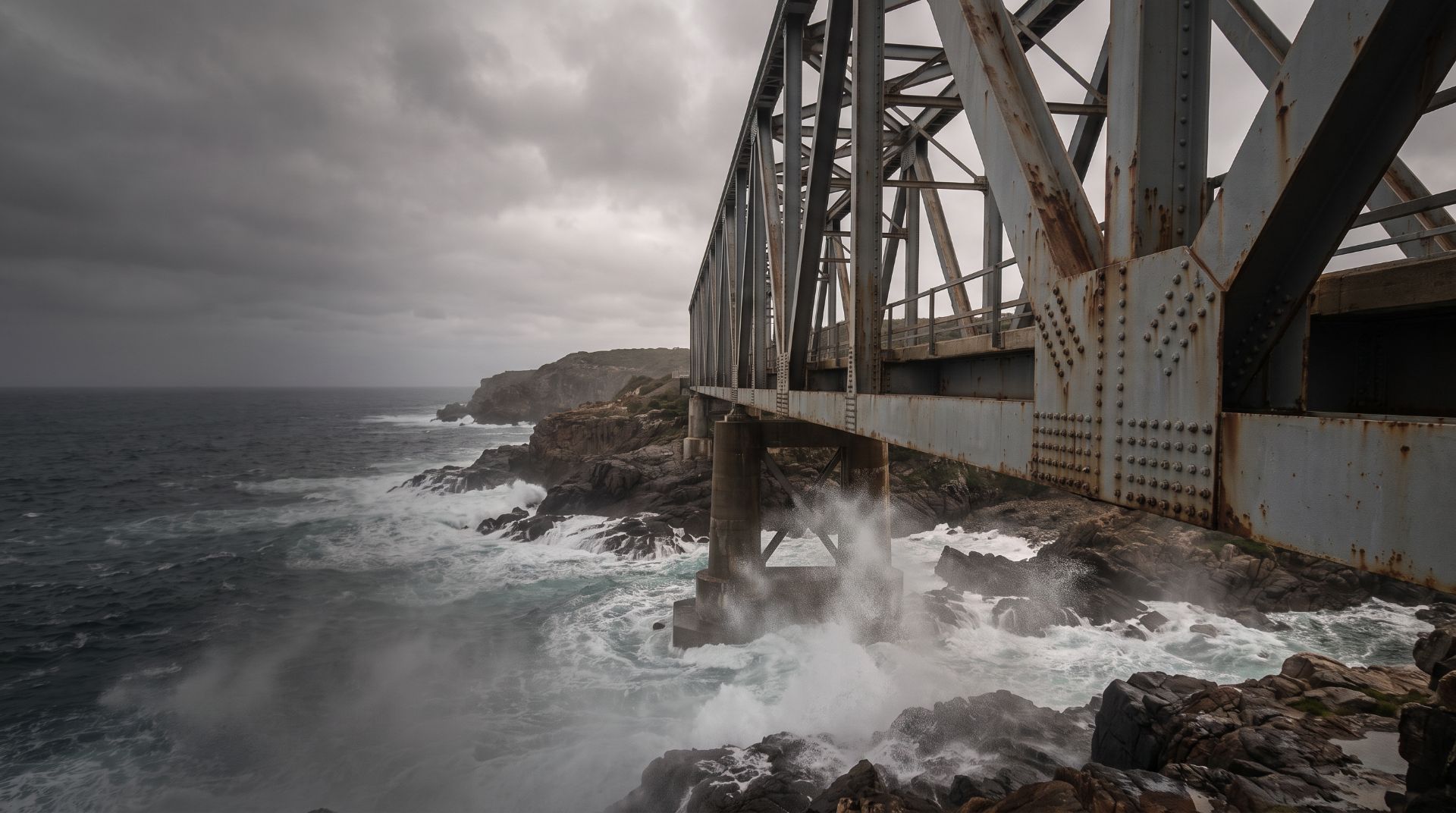 Coastal steel takes the hardest hit
Rust creep is corrosion that starts at a scratch, a cut edge or a damaged thread, then spreads sideways underneath the coating. From the outside the coating looks fine while the steel underneath is being eaten away. On bolts it starts where the coating takes a knock: the threads, the head and the nut face.
- No creep at the cut
In the independent BBA HAPAS assessment, Greenkote passed 1,000 hours of salt spray with no creep at the cut, plus humidity, sulphur dioxide and UV ageing tests.
- No layer to creep under
Paints and plated finishes sit on top of the steel, so corrosion can travel along the boundary between the two. Greenkote is diffused into the steel surface, so there is no boundary for rust to travel along.
- Zinc protects the damage
If the coating is scratched, the zinc in Greenkote corrodes first and protects the exposed steel around it.
- Aluminium seals the gaps
Aluminium-rich phases in the coating help seal micro-cracks and porosity before moisture gets in.
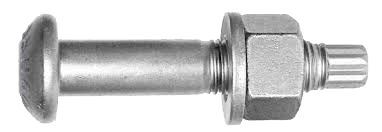 TCB assembly with Greenkote
Why Greenkote
Built for high strength bolts. Cleaner too.
- Bonded into the steel
A zinc and aluminium coating applied by a patented thermo-chemical diffusion process after shot blasting. It is metallurgically bonded to the bolt, not sitting on top.
- No acid pickling
Hot dip galvanising usually starts with an acid pickle, a known source of hydrogen in high strength steel. Greenkote is applied after shot blasting, and TCB states it eliminates hydrogen embrittlement issues.
- Thin and even, so the nut fits
At about 35 µm nominal with tight uniformity, there is no need to over-tap the nut. That keeps thread strength and gives consistent tightening.
- Ready for paint
The fine texture accepts all paint systems. Protect the sheared spline end with zinc-rich primer or a cap.
- Cleaner process
No hexavalent chromium, cadmium, acids, cyanides or chlorides, and about half the energy of traditional coating methods.
Side by side
Greenkote vs hot dip galvanising.
| Greenkote (TCB) | Hot dip galvanised bolts | |
|---|---|---|
| Process | Shot blast, then zinc and aluminium thermally diffused into the surface | Acid pickle, then dip in molten zinc |
| Thickness | 25 µm minimum local, about 35 µm nominal | 40 µm minimum local, 50 µm minimum average (AS/NZS 1214) |
| Nut fit | Standard fit, no over-tapping | Nuts over-tapped to suit the thicker coating, which reduces thread stripping strength |
| Tightening | Consistent, preload set by the spline | Wide torque-tension scatter when used as galvanised |
| Hydrogen embrittlement | No acid pickling. TCB states the process eliminates the issue | Risk rises above about 1,000 MPa and depends on the process. Blasting instead of pickling is recommended for 10.9 |
| Rust creep test | No creep at the cut after 1,000 h salt spray (BBA HAPAS) | Depends on coating thickness and environment |
Sources: TCB Greenkote data sheet and BBA HAPAS certificate 07/H127; Galvanizers Association of Australia and NZ, Guide for HDG Bolts and Bolted Joints (2025).
Corrosivity check
How tough is your site?
ISO 9223 sorts environments into corrosivity categories from C1 to CX. Pick the one closest to your project to see how hard it is on zinc coatings, and how Greenkote's rating compares.
Zinc first-year corrosion rates from ISO 9223. "High" durability is 15 to 25 years under ISO 12944-1, a planning range rather than a guarantee. Always check the project specification.
Grip length finder
Find the right bolt length.
Each TCB length suits a range of grip: the total thickness clamped between the underside of the head and the washer. Choose a diameter, enter your grip and we'll show the assemblies that fit, shortest first.
Grip ranges from TCB grip tolerance table RD-TEC-003 (October 2025) for one washer and a standard shear wrench. For two washers or a corner wrench, check RD-TEC-004 and RD-TEC-006. Confirm against your connection design.
Shear wrench selector
Match the wrench to the bolt.
TCB shear wrenches come in corded, cordless and corner versions. Pick a bolt size and how many bolts you have to install to see which wrenches suit, and how many battery charges a cordless job needs.
Wrench data from TCB specification sheets. Bolts per charge are TCB's figures for a 36 V 4.0 Ah battery. Wrenches should be serviced every 6 months or 30,000 bolts.
Engineering data
Preload and design resistance.
| Size | Tensile stress area As (mm²) | Min. preload Fp,C (kN) | Tension resistance Ft,Rd (kN) | Shear, single plane Fv,Rd (kN) | Shear, double plane Fv,Rd (kN) |
|---|---|---|---|---|---|
| M12 | 84.3 | 59 | 60.7 | 28.7 | 57.3 |
| M16 | 157 | 110 | 113 | 62.8 | 125.6 |
| M20 | 245 | 172 | 176 | 98.0 | 196 |
| M22 | 303 | 212 | 218 | 121 | 242 |
| M24 | 353 | 247 | 254 | 141 | 282 |
| M27 | 459 | 321 | 330 | 184 | 367 |
| M30 | 561 | 393 | 404 | 224 | 449 |
| M36 | 817 | 572 | 588 | 327 | 654 |
Class 10.9 TCB assemblies. Preload from TCB RD-TEC-002. Resistances from TCB bolt resistance tables, calculated to EN 1993-1-8 with the UK National Annex: for Australian projects, design to AS 4100. Slip resistance by slip class is in the TCB tables in the resources below.
On site
Installation checklist.
- Train the crew. AS/NZS 5131 expects TCB installers to be trained by the supplier.
- Store dry. Keep assemblies clean, dry and covered. Don't add lubricant or mix batches.
- Check the grip. At least one thread past the nut, and four full threads clear.
- Washer in the right place. Under the nut, chamfer outwards, nut markings facing out.
- Snug first. Bring every bolt to snug tight, from the stiffest part of the joint out.
- Two stages on big groups. Bed all bolts without shearing, then shear every spline, centre outwards.
- Mask before painting. Keep paint off faying surfaces and under heads and washers. No T-wash.
- Seal the ends. Touch up sheared spline ends with zinc-rich primer or fit caps.
- Inspect by eye. Every spline sheared. Replace any bolt that broke or stripped.
- Never reuse. Tensioned TCBs go in the bin, not back in the drum.
Proven on major projects
Trusted where it counts.
West Gate Bridge, Melbourne
TCBs used in the bridge strengthening works.
NZ International Convention Centre
Greenkote TCBs, mostly M30, in 8,500 t of steel. Supplied by Konnect.
Sydney Harbour Bridge
TCB has supplied bolts for Australia's best known bridge.
London Olympic Stadium
Approximately 300,000 TCBs in the stadium steelwork.
Source: Tension Control Bolts Ltd project records.
Questions
TCB and Greenkote FAQ.
Are tension control bolts allowed under Australian standards?
Yes. The Australian Steel Institute notes TCBs fall under AS/NZS 5131 clause 8.7 for specialised fasteners and tensioning methods. They must be installed by competent people trained by the supplier, to the manufacturer's specification, until the spline breaks. Your design engineer accepts them through the project specification.
What preload does a TCB give?
The minimum preload is Fp,C = 0.7 × fub × As: 59 kN for M12, 110 kN for M16, 172 kN for M20, up to 572 kN for M36. See the preload table above.
Does the shear wrench need calibrating?
No. The torque is set by the bolt itself, through the shear groove on the spline, so the wrench needs no calibration. Wrenches do need servicing every 6 months or 30,000 bolts.
How are TCBs inspected?
Visually. A sheared spline shows the bolt reached its preload. If an assembly fails to safe, it breaks in torsion or strips its thread, which is easy to see, and it is replaced.
Can I use the part-turn method instead?
AS/NZS 5131 does not allow part-turn tightening on grade 10.9 bolts unless its suitability has been established. TCBs avoid the question by setting tension through the spline.
Can TCBs be reused?
No. Once a TCB is tensioned it must not be reused. They can be used as temporary slave bolts during erection, but must be marked and replaced.
How many washers do I need?
One washer under the nut (the part that turns) on steel above S235. On S235 steel, use washers under both the head and the nut. Up to two extra washers, 12 mm or less combined, can adjust the grip. Use plate washers for slotted or oversize holes. Fit washers chamfer outwards.
How do I choose the right length?
Use the grip length finder above. Each length suits a range of grip, so that at least one thread pitch protrudes past the nut and four full threads plus run-out sit clear of it. If your grip is below the minimum, add a washer.
Can Greenkote TCBs be painted?
Yes, Greenkote accepts all paint systems and does not need a T-wash. Mask faying surfaces and the areas under the head and washer before painting, because paint there can creep and reduce preload. Seal the sheared spline end with zinc-rich primer or a cap.
How should TCBs be stored and handled?
Keep them clean, dry and under cover in their drums. Do not add lubricant, do not mix batches, and discard any assembly that is dirty, oily, rusty or does not run freely. Wet, dirty or hot conditions can make a bolt fail to safe.
Why Greenkote rather than hot dip galvanising?
Greenkote is applied after shot blasting with no acid pickle, is thin and even so nuts are not over-tapped, and passed 1,000 hours of salt spray with no creep at the cut in BBA HAPAS testing. TCB states it eliminates hydrogen embrittlement issues in high strength fasteners.
What sizes are available?
TCB Greenkote assemblies come in M12, M16, M20, M22, M24, M27, M30 and M36, from 30 mm up to 280 mm long depending on diameter. Shop online or ask your local branch.
Resources
Technical downloads.
Specifying for a project?
Talk to our structural team.
Konnect is the exclusive Australian and New Zealand distributor for TCB. We can help with grip lengths, quantities, arranging installer training and supply for your next steel package.